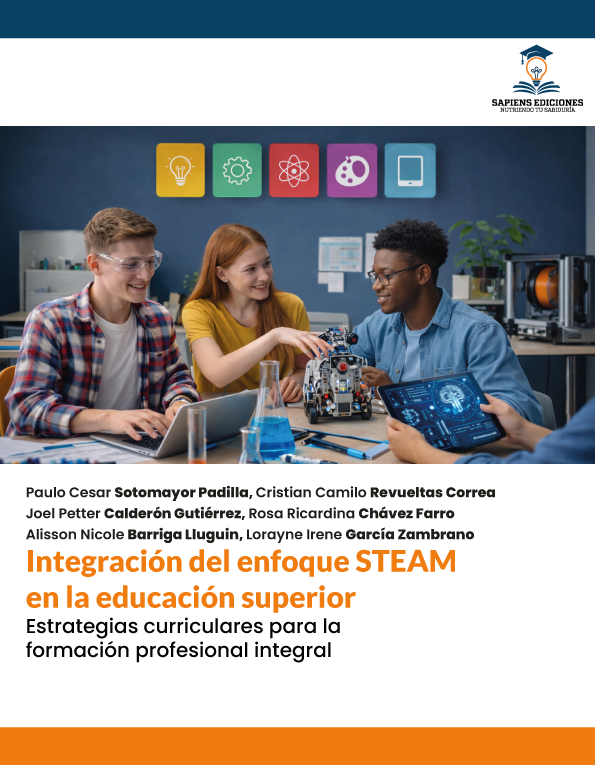
Integración del Enfoque STEAM en la Educación Superior: Estrategias Curriculares para la Formación Profesional Integral analiza la importancia de integrar ciencia, tecnología, ingeniería, artes y matemáticas en la formación universitaria como una estrategia para fortalecer la innovación educativa y el desarrollo de competencias profesionales. La obra examina el aprendizaje interdisciplinario, el diseño curricular basado en STEAM y la aplicación de metodologías activas como el aprendizaje basado en proyectos y problemas. Asimismo, aborda la incorporación de tecnologías emergentes en los procesos educativos para fomentar el pensamiento crítico, la creatividad, la colaboración y la resolución de problemas complejos, destacando los desafíos y oportunidades que enfrentan las universidades para formar profesionales capaces de responder a los retos científicos, tecnológicos y sociales del siglo XXI.
Publicado: 15 de Marzo del 2026
ISBN: 978-9907-9517-1-4
Derechos de autor: © 2026 Paulo Cesar Sotomayor Padilla; Cristian Camilo Revueltas Correa; Joel Petter Calderón Gutiérrez; Rosa Ricardina Chávez Farro; Alisson Nicole Barriga Lluguin; Lorayne Irene García Zambrano

Licencia: Esta obra está bajo una Creative Commons Atribución-NoComercial-CompartirIgual 4.0
Autores
-

Corporación Sotomayor Corpsot S.A.S, Babahoyo – Ecuador
-

-

-

-
-

Sinopsis
Integración del Enfoque STEAM en la Educación Superior: Estrategias Curriculares para la Formación Profesional Integral analiza el papel del enfoque STEAM como una propuesta educativa innovadora que integra ciencia, tecnología, ingeniería, artes y matemáticas para fortalecer la formación profesional en el contexto de la sociedad del conocimiento. La obra examina los fundamentos del aprendizaje interdisciplinario, el diseño curricular basado en STEAM y la aplicación de metodologías activas que promueven el pensamiento crítico, la creatividad y la resolución de problemas complejos. Asimismo, reflexiona sobre la incorporación de tecnologías emergentes en los procesos educativos y los desafíos que enfrentan las universidades para implementar modelos pedagógicos innovadores. A través de un enfoque académico y reflexivo, el libro destaca el potencial del enfoque STEAM para impulsar la innovación educativa y preparar profesionales capaces de responder a los retos científicos, tecnológicos y sociales del siglo XXI.
Palabras clave: STEAM; educación superior; innovación educativa; currículo interdisciplinario; metodologías activas; tecnologías emergentes.
Autores
-
-
-
-
-
-
Citas
Al-Youbi, A., Al-Hadrami, A., Al-Eraky, M., & Al-Drees, T. (2020). The leading world’s most innovative universities. Springer.
Altbach, P. G., & Knight, J. (2007). The internationalization of higher education: Motivations and realities. Journal of Studies in International Education, 11(3–4), 290–305.
https://doi.org/10.1177/1028315307303542
Anderson, T. (2008). The theory and practice of online learning. AU Press.
Anderson, T., & Dron, J. (2011). Three generations of distance education pedagogy. International Review of Research in Open and Distributed Learning, 12(3), 80–97.
https://doi.org/10.19173/irrodl.v12i3.890
Azuma, R. T. (1997). A survey of augmented reality. Presence: Teleoperators and Virtual Environments, 6(4), 355–385. https://doi.org/10.1162/pres.1997.6.4.355
Bacca, J., Baldiris, S., Fabregat, R., Graf, S., & Kinshuk. (2014). Augmented reality trends in education: A systematic review of research and applications. Educational Technology & Society, 17(4), 133–149.
Bates, A. W. (2015). Teaching in a digital age: Guidelines for designing teaching and learning. BCcampus.
Beane, J. (1997). Curriculum integration: Designing the core of democratic education. Teachers College Press.
Bell, S. (2010). Project-based learning for the 21st century: Skills for the future. The Clearing House, 83(2), 39–43. https://doi.org/10.1080/00098650903505415
Biggs, J., & Tang, C. (2011). Teaching for quality learning at university (4th ed.). Open University Press.
Black, P., & Wiliam, D. (2009). Developing the theory of formative assessment. Educational Assessment, Evaluation and Accountability, 21(1), 5–31. https://doi.org/10.1007/s11092-008-9068-5
Blikstein, P. (2013). Digital fabrication and ‘making’ in education. FabLabs Research.
Blumenfeld, P., Soloway, E., Marx, R., Krajcik, J., Guzdial, M., & Palincsar, A. (1991). Motivating project-based learning. Educational Psychologist, 26(3–4), 369–398.
https://doi.org/10.1080/00461520.1991.9653139
Bonwell, C., & Eison, J. (1991). Active learning: Creating excitement in the classroom. ASHE-ERIC Higher Education Report.
Brookhart, S. (2013). How to create and use rubrics for formative assessment and grading. ASCD.
Clark, B. (1998). Creating entrepreneurial universities: Organizational pathways of transformation. Pergamon.
Daniel, B. (2015). Big data and analytics in higher education. British Journal of Educational Technology, 46(5), 904–920. https://doi.org/10.1111/bjet.12230
Darling-Hammond, L., Hyler, M., & Gardner, M. (2017). Effective teacher professional development. Learning Policy Institute.
Deming, W. E. (1986). Out of the crisis. MIT Press.
Dweck, C. (2006). Mindset: The new psychology of success. Random House.
Etzkowitz, H. (2003). Innovation in innovation: The triple helix of university–industry–government relations. Social Science Information, 42(3), 293–337.
https://doi.org/10.1177/05390184030423002
Etzkowitz, H. (2008). The triple helix: University–industry–government innovation in action. Routledge.
Facione, P. (2011). Critical thinking: What it is and why it counts. Insight Assessment.
Ferguson, R. (2012). Learning analytics: Drivers, developments and challenges. International Journal of Technology Enhanced Learning, 4(5–6), 304–317.
https://doi.org/10.1504/IJTEL.2012.051816
Florida, R. (2002). The rise of the creative class. Basic Books.
Freeman, S., Eddy, S., McDonough, M., Smith, M., Okoroafor, N., Jordt, H., & Wenderoth, M. (2014). Active learning increases student performance in science, engineering, and mathematics. Proceedings of the National Academy of Sciences, 111(23), 8410–8415. https://doi.org/10.1073/pnas.1319030111
Freina, L., & Ott, M. (2015). A literature review on immersive virtual reality in education. eLearning & Software for Education, 1, 133–141.
Grech, A., & Camilleri, A. (2017). Blockchain in education. European Commission.
Gulikers, J., Bastiaens, T., & Kirschner, P. (2004). A five-dimensional framework for authentic assessment. Educational Technology Research and Development, 52(3), 67–86. https://doi.org/10.1007/BF02504676
Guskey, T. (2000). Evaluating professional development. Corwin Press.
Harden, R. (2002). Learning outcomes and instructional objectives. Medical Teacher, 24(2), 151–155. https://doi.org/10.1080/0142159022020687
Hargreaves, A., & Fink, D. (2006). Sustainable leadership. Jossey-Bass.
Harvey, L., & Green, D. (1993). Defining quality. Assessment & Evaluation in Higher Education, 18(1), 9–34. https://doi.org/10.1080/0260293930180102
Holmes, W., Bialik, M., & Fadel, C. (2019). Artificial intelligence in education. Center for Curriculum Redesign.
Johnson, D., & Johnson, R. (2009). Cooperative learning. Educational Researcher, 38(5), 365–379. https://doi.org/10.3102/0013189X09339057
Jonassen, D. (1999). Designing constructivist learning environments. Routledge.
Kolb, D. (1984). Experiential learning. Prentice Hall.
Kwok, L. (2015). A vision for smart campus. International Journal of Innovation and Learning, 18(3), 304–321.
Larmer, J., Mergendoller, J., & Boss, S. (2015). Setting the standard for project-based learning. ASCD.
Laurillard, D. (2012). Teaching as a design science. Routledge.
Lave, J., & Wenger, E. (1991). Situated learning. Cambridge University Press.
Ledford, H. (2015). How to solve the world’s biggest problems. Nature, 525(7569), 308–311. https://doi.org/10.1038/525308a
Lee, L. H., Braud, T., Zhou, P., Wang, L., Xu, D., Lin, Z., Kumar, A., Bermejo, C., & Hui, P. (2021). All one needs to know about metaverse. IEEE Access, 9, 133752–133771.
https://doi.org/10.1109/ACCESS.2021.3118768
Luckin, R., Holmes, W., Griffiths, M., & Forcier, L. (2016). Intelligence unleashed: An argument for AI in education. Pearson.
Makransky, G., & Petersen, G. (2019). Immersive virtual reality and learning. Educational Psychology Review. https://doi.org/10.1007/s10648-019-09487-2
Ma, J., & Nickerson, J. (2006). Hands-on, simulated and remote laboratories. ACM Computing Surveys, 38(3). https://doi.org/10.1145/1132960.1132961
Marginson, S. (2016). The dream is over. University of California Press.
Mishra, P., & Koehler, M. (2006). Technological pedagogical content knowledge. Teachers College Record, 108(6), 1017–1054.
Neck, H., & Greene, P. (2011). Entrepreneurship education. Journal of Small Business Management, 49(1), 55–70. https://doi.org/10.1111/j.1540-627X.2010.00314.x
Ng, W. (2012). Can we teach digital natives digital literacy? Computers & Education, 59(3), 1065–1078.https://doi.org/10.1016/j.compedu.2012.04.016
OECD. (2019). Future of education and skills 2030. OECD Publishing.
Oliver, B. (2019). Making micro-credentials work. Journal of Teaching and Learning for Graduate Employability, 10(1), 44–60.
Radianti, J., Majchrzak, T., Fromm, J., & Wohlgenannt, I. (2020). Immersive virtual reality applications for higher education. Computers & Education, 147, 103778. https://doi.org/10.1016/j.compedu.2019.103778
Robinson, K. (2011). Out of our minds: Learning to be creative. Capstone.
Schein, E. (2010). Organizational culture and leadership. Jossey-Bass.
Schön, D. (1983). The reflective practitioner. Basic Books.
Selwyn, N. (2016). Education and technology. Bloomsbury.
Siemens, G. (2013). Learning analytics. American Behavioral Scientist, 57(10), 1380–1400.
https://doi.org/10.1177/0002764213498851
Tapscott, D., & Tapscott, A. (2017). Blockchain revolution. Portfolio.
Tao, F., Qi, Q., Liu, A., & Kusiak, A. (2019). Digital twins and cyber–physical systems. IEEE Transactions on Industrial Informatics, 15(4), 2405–2414. https://doi.org/10.1109/TII.2018.2872664
UNESCO. (2017). Education for sustainable development goals. UNESCO.
Williamson, B., & Eynon, R. (2020). Historical threads in AI in education. Learning, Media and Technology, 45(3), 223–235. https://doi.org/10.1080/17439884.2020.1798995
World Economic Forum. (2020). The future of jobs report. WEF.
Yakman, G., & Lee, H. (2012). Exploring the exemplary STEAM education. Journal of the Korean Association for Science Education, 32(6), 1072–1086. https://doi.org/10.14697/jkase.2012.32.6.1072
Autores
-
-
-
-
-
-
Como citar
APA:
Sotomayor Padilla, P. C., Revueltas Correa, C. C., Calderón Gutiérrez, J. P., Chávez Farro, R. R., Barriga Lluguin, A. N., & García Zambrano, L. I. (2026). Integración del Enfoque STEAM en la Educación Superior: Estrategias Curriculares para la Formación Profesional Integral. Sapiens Ediciones.https://sapiensediciones.com/product/integracion-del-enfoque-steam-en-la-educacion-superior/
Sotomayor Padilla, P. C., Revueltas Correa, C. C., Calderón Gutiérrez, J. P., Chávez Farro, R. R., Barriga Lluguin, A. N., & García Zambrano, L. I. (2026). Integración del Enfoque STEAM en la Educación Superior: Estrategias Curriculares para la Formación Profesional Integral. Sapiens Ediciones.https://sapiensediciones.com/product/integracion-del-enfoque-steam-en-la-educacion-superior/
Vancouver:
Sotomayor Padilla PC, Revueltas Correa CC, Calderón Gutiérrez JP, Chávez Farro RR, Barriga Lluguin AN, García Zambrano LI. Integración del Enfoque STEAM en la Educación Superior: Estrategias Curriculares para la Formación Profesional Integral. Sapiens Ediciones; 2026.
https://sapiensediciones.com/product/integracion-del-enfoque-steam-en-la-educacion-superior/
Sotomayor Padilla PC, Revueltas Correa CC, Calderón Gutiérrez JP, Chávez Farro RR, Barriga Lluguin AN, García Zambrano LI. Integración del Enfoque STEAM en la Educación Superior: Estrategias Curriculares para la Formación Profesional Integral. Sapiens Ediciones; 2026.
https://sapiensediciones.com/product/integracion-del-enfoque-steam-en-la-educacion-superior/
Autores
-
-
-
-
-
-
Indexaciones





Esta obra cuenta con registro ISBN y forma parte de plataformas académicas y redes de visibilidad científica.
Autores
-
-
-
-
-
-