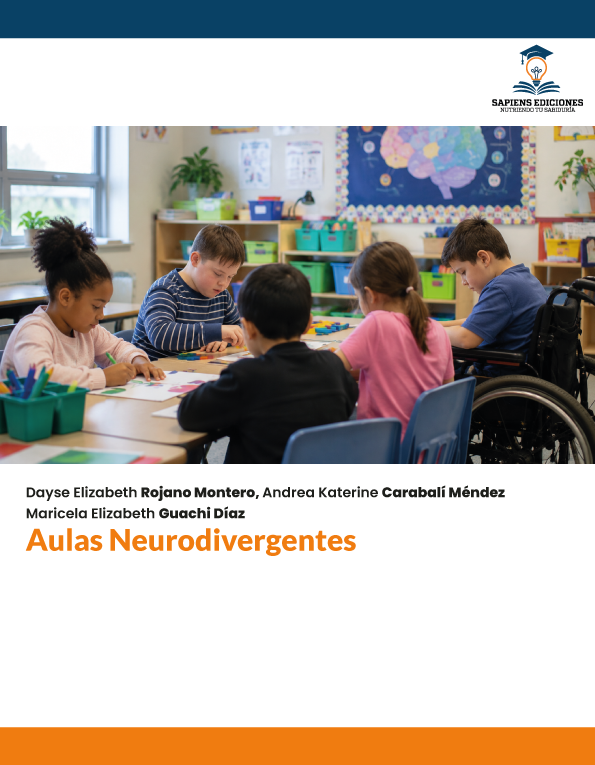
Aulas Neurodivergentes aborda la neurodiversidad y la neuroinclusión desde una perspectiva educativa orientada a comprender las distintas formas de procesar información, comunicarse, participar y aprender. La obra analiza perfiles neurodivergentes como el autismo, el TDAH, la dislexia, las dificultades específicas relacionadas con las matemáticas y los trastornos de coordinación, destacando la heterogeneidad individual y la necesidad de superar enfoques centrados exclusivamente en el déficit. Asimismo, examina las barreras pedagógicas, sensoriales, comunicativas, ejecutivas, evaluativas, sociales y emocionales que pueden limitar el aprendizaje y la participación. Desarrolla criterios para diseñar aulas neuroinclusivas mediante ambientes accesibles, organización espacial, rutinas, predictibilidad, apoyos visuales y estrategias de autorregulación. También incorpora metodologías activas, personalización del aprendizaje, gamificación, tecnología educativa, inteligencia artificial, aprendizaje cooperativo y evaluación flexible, manteniendo como principios la accesibilidad, la autonomía y el rigor académico. Finalmente, enfatiza la importancia del bienestar, la convivencia y el sentido de pertenencia, proponiendo una cultura escolar que reconozca la diversidad neurológica desde la planificación y promueva experiencias educativas más inclusivas, flexibles y significativas.
Publicado: 28 de agosto del 2026
ISBN: 978-9907-9579-1-4
Derechos de autor: © 2026 Dayse Elizabeth Rojano Montero; Andrea Katerine Carabalí Méndez; Maricela Elizabeth Guachi Díaz

Licencia: Esta obra está bajo una Creative Commons Atribución-NoComercial-CompartirIgual 4.0
Autores
-

Universidad Estatal Amazónica – Ecuador
-

-


Sinopsis
Aulas Neurodivergentes aborda la neurodiversidad y la neuroinclusión desde una perspectiva educativa orientada a comprender las distintas formas de procesar información, comunicarse, participar y aprender. La obra analiza perfiles neurodivergentes como el autismo, el TDAH, la dislexia, las dificultades específicas relacionadas con las matemáticas y los trastornos de coordinación, destacando la heterogeneidad individual y la necesidad de superar enfoques centrados exclusivamente en el déficit. Asimismo, examina las barreras pedagógicas, sensoriales, comunicativas, ejecutivas, evaluativas, sociales y emocionales que pueden limitar el aprendizaje y la participación. Desarrolla criterios para diseñar aulas neuroinclusivas mediante ambientes accesibles, organización espacial, rutinas, predictibilidad, apoyos visuales y estrategias de autorregulación. También incorpora metodologías activas, personalización del aprendizaje, gamificación, tecnología educativa, inteligencia artificial, aprendizaje cooperativo y evaluación flexible, manteniendo como principios la accesibilidad, la autonomía y el rigor académico. Finalmente, enfatiza la importancia del bienestar, la convivencia y el sentido de pertenencia, proponiendo una cultura escolar que reconozca la diversidad neurológica desde la planificación y promueva experiencias educativas más inclusivas, flexibles y significativas.
Palabras clave: neurodiversidad; neuroinclusión; educación inclusiva; aulas neuroinclusivas; estrategias pedagógicas.
Autores
-
-
-
Como Citar
APA:
Rojano Montero, D. E., Carabalí Méndez, A. K., & Guachi Díaz, M. E. (2026). Aulas neurodivergentes. Sapiens Ediciones. https://sapiensediciones.com/product/aulas-neurodivergentes/
Rojano Montero, D. E., Carabalí Méndez, A. K., & Guachi Díaz, M. E. (2026). Aulas neurodivergentes. Sapiens Ediciones. https://sapiensediciones.com/product/aulas-neurodivergentes/
Vancouver:
Rojano Montero DE, Carabalí Méndez AK, Guachi Díaz ME. Aulas neurodivergentes. Sapiens Ediciones; 2026. https://sapiensediciones.com/product/aulas-neurodivergentes/
Rojano Montero DE, Carabalí Méndez AK, Guachi Díaz ME. Aulas neurodivergentes. Sapiens Ediciones; 2026. https://sapiensediciones.com/product/aulas-neurodivergentes/
Autores
-
-
-
Referencias
Abregú-Crespo, R., Garriz-Luis, A., Ayora, M., Martín-Martínez, N., Cavone, V., Carrasco, M. Á., Fraguas, D., Martín-Babarro, J., Arango, C., & Díaz-Caneja, C. M. (2024). School bullying in children and adolescents with neurodevelopmental and psychiatric conditions: A systematic review and meta-analysis. The Lancet Child & Adolescent Health, 8(2), 122–134. https://doi.org/10.1016/S2352-4642(23)00289-4
Adams, D., Dargue, N., Malone, S., Carroll, A., & Simpson, K. (2025). Are sensory aspects of the built school environment associated with learning or well-being outcomes for autistic students? A systematic review. International Journal of Inclusive Education. Advance online publication. https://doi.org/10.1080/13603116.2025.2589290
Alotaibi, M. S. (2024). Game-based learning in early childhood education: A systematic review and meta-analysis. Frontiers in Psychology, 15, 1307881. https://doi.org/10.3389/fpsyg.2024.1307881
Atkinson, E., Wright, S., & Wood-Downie, H. (2025). “Do my friends only like the school me or the true me?”: School belonging, camouflaging, and anxiety in autistic students. Journal of Autism and Developmental Disorders. https://doi.org/10.1007/s10803-024-06668-w
Basantes, A. V., Guerra, F. E., Naranjo, M. E., & Ibadango, D. K. (2018). Los lectores de pantalla: Herramientas tecnológicas para la inclusión educativa de personas no videntes. Información Tecnológica, 29(5), 81–90. https://doi.org/10.4067/S0718-07642018000500081
Blank, R., Barnett, A. L., Cairney, J., Green, D., Kirby, A., Polatajko, H., Rosenblum, S., Smits-Engelsman, B., Sugden, D., Wilson, P., & Vinçon, S. (2019). International clinical practice recommendations on the definition, diagnosis, assessment, intervention, and psychosocial aspects of developmental coordination disorder. Developmental Medicine & Child Neurology, 61(3), 242–285. https://doi.org/10.1111/dmcn.14132
Carneiro, T., Carvalho, A., Frota, S., & Filipe, M. G. (2024). Serious games for developing social skills in children and adolescents with autism spectrum disorder: A systematic review. Healthcare, 12(5), 508. https://doi.org/10.3390/healthcare12050508
Chacko, A., Merrill, B. M., Kofler, M. J., & Fabiano, G. A. (2024). Improving the efficacy and effectiveness of evidence-based psychosocial interventions for attention-deficit/hyperactivity disorder (ADHD) in children and adolescents. Translational Psychiatry, 14, 244. https://doi.org/10.1038/s41398-024-02890-3
Chen, J.-W., & Zhu, K. (2024). Single exercise for core symptoms and executive functions in ADHD: A systematic review and meta-analysis. Journal of Attention Disorders, 28(4), 399–414. https://doi.org/10.1177/10870547231217321
Cohen, K. A., Ito, S., Ahuvia, I. L., Yang, Y., Zhang, Y., Renshaw, T. L., Larson, M., Cook, C., Hill, S., Liao, J. L., Rapoport, A., Smock, A., Yang, M., & Schleider, J. L. (2024). Brief school-based interventions targeting student mental health or well-being: A systematic review and meta-analysis. Clinical Child and Family Psychology Review, 27(3), 732–806. https://doi.org/10.1007/s10567-024-00487-2
DuPaul, G. J., Evans, S. W., Cleminshaw-Mahan, C. L., & Fu, Q. (2024). School-based intervention for adolescents with ADHD: Predictors of effects on academic, behavioral, and social functioning. Behavior Therapy, 55(4), 680–697. https://doi.org/10.1016/j.beth.2024.01.010
Esqueda Villegas, F., van der Steen, S., & Minnaert, A. (2024). Interactions between teachers and students with autism spectrum disorder in mainstream secondary education: Fundamental, yet under-researched. Review Journal of Autism and Developmental Disorders, 11, 442–457.
Faraone, S. V., Banaschewski, T., Coghill, D., Zheng, Y., Biederman, J., Bellgrove, M. A., Newcorn, J. H., Gignac, M., Al Saud, N. M., Manor, I., Rohde, L. A., Yang, L., Cortese, S., et al. (2021). The World Federation of ADHD International Consensus Statement: 208 evidence-based conclusions about the disorder. Neuroscience & Biobehavioral Reviews, 128, 789–818. https://doi.org/10.1016/j.neubiorev.2021.01.022
Forbes, A. S., & Yun, J. (2023). Visual supports for children with autism in physical activity. Adapted Physical Activity Quarterly, 40(4), 781–806. https://doi.org/10.1123/apaq.2022-0157
Granieri, J. E., Mulcahy, C. A., Grosso, M., & Gillis Mattson, J. M. (2025). Inclusion practices for elementary autistic students: A systematic review. Inclusion, 13(2), 63–86. https://doi.org/10.1352/2326-6988-13.2.63
Hasson, L., Keville, S., Gallagher, J., Onagbesan, D., & Ludlow, A. K. (2022). Inclusivity in education for autism spectrum disorders: Experiences of support from the perspective of parent/carers, school teaching staff and young people on the autism spectrum. International Journal of Developmental Disabilities, 69, 201–212. https://doi.org/10.1080/20473869.2022.2070418
Honorato, N., Soltiyeva, A., Oliveira, W., Delabrida, S. E., Hamari, J., & Alimanova, M. (2024). Gameful strategies in the education of autistic children: A systematic literature review, scientometric analysis, and future research roadmap. Smart Learning Environments, 11, 25. https://doi.org/10.1186/s40561-024-00309-6
Jones, E., Hanley, M., Riby, D. M., & Rodgers, J. (2026). The effect of the classroom sensory environment on engagement for autistic pupils: Classroom noise and classroom displays. Autism & Developmental Language Impairments. https://doi.org/10.1177/27546330261443570
Kapp, S. K., Gillespie-Lynch, K., Sherman, L. E., & Hutman, T. (2013). Deficit, difference, or both? Autism and neurodiversity. Developmental Psychology, 49(1), 59–71. https://doi.org/10.1037/a0028353
Leonardi, S., Di Cara, M., Giliberto, S., Piccolo, A., De Domenico, C., Leonardi, G., Alito, A., Siracusano, R., Calabrò, R. S., Quartarone, A., & Cucinotta, F. (2025). The use of multisensory environments in children and adults with autism spectrum disorder: A systematic review. Autism, 29(8), 1921–1938. https://doi.org/10.1177/13623613251320424
Li, B., Heyne, D., Scheeren, A., Blijd-Hoogewys, E., & Rieffe, C. (2024). School participation of autistic youths: The influence of youth, family and school factors. Autism, 28(9), 2295–2310. https://doi.org/10.1177/13623613231225490
Li, J., & Deng, S. W. (2023). Facilitation and interference effects of the multisensory context on learning: A systematic review and meta-analysis. Psychological Research, 87(5), 1334–1352. https://doi.org/10.1007/s00426-022-01733-4
Liu, X., Yang, Y., Ye, Z., Wang, F., Zeng, K., Sun, Y., Huang, Y., & Dai, L. (2024). The effect of digital interventions on attention deficit hyperactivity disorder (ADHD): A meta-analysis of randomized controlled trials. Journal of Affective Disorders, 365, 563–577. https://doi.org/10.1016/j.jad.2024.08.156
Lord, C., Brugha, T. S., Charman, T., Cusack, J., Dumas, G., Frazier, T., Jones, E. J. H., Jones, R. M., Pickles, A., State, M. W., Taylor, J. L., & Veenstra-VanderWeele, J. (2020). Autism spectrum disorder. Nature Reviews Disease Primers, 6, Article 5. https://doi.org/10.1038/s41572-019-0138-4
Mallory, C., & Keehn, B. (2021). Implications of sensory processing and attentional differences associated with autism in academic settings: An integrative review. Frontiers in Psychiatry, 12, 695825. https://doi.org/10.3389/fpsyt.2021.695825
McKinlay, M., Thorpe, D., Cage, E., Grainger, C., Jasper, C., & Stewart, M. (2025). A systematic review: Which psycho-social-environmental factors do autistic students identify as being important for positive experiences in mainstream secondary school? Autism, 29(3), 566–578.
Moriña, A., Carballo, R., & Castellano-Beltran, A. (2024). A systematic review of the benefits and challenges of technologies for the learning of university students with disabilities. Journal of Special Education Technology, 39(1). https://doi.org/10.1177/01626434231175357
Pellicano, E., & den Houting, J. (2022). Annual Research Review: Shifting from “normal science” to neurodiversity in autism science. Journal of Child Psychology and Psychiatry, 63(4), 381–396. https://doi.org/10.1111/jcpp.13534
Peterson, B. S., Trampush, J., Maglione, M., Bolshakova, M., Rozelle, M., Miles, J., Pakdaman, S., Brown, M., Yagyu, S., Motala, A., & Hempel, S. (2024). Treatments for ADHD in children and adolescents: A systematic review. Pediatrics, 153(4), e2024065787. https://doi.org/10.1542/peds.2024-065787
Peterson, R. L., & Pennington, B. F. (2015). Developmental dyslexia. Annual Review of Clinical Psychology, 11, 283–307. https://doi.org/10.1146/annurev-clinpsy-032814-112842
Pulliam, G., Feldman, J. I., & Woynaroski, T. G. (2023). Audiovisual multisensory integration in individuals with reading and language impairments: A systematic review and meta-analysis. Neuroscience & Biobehavioral Reviews, 149, 105130. https://doi.org/10.1016/j.neubiorev.2023.105130
Rajotte, É., Grandisson, M., Hamel, C., Couture, M. M., Desmarais, C., Gravel, M., & Chrétien-Vincent, M. (2023). Inclusion of autistic students: Promising modalities for supporting a school team. Disability and Rehabilitation, 45(7), 1258–1268. https://doi.org/10.1080/09638288.2022.2057598
Raniti, M., Rakesh, D., Patton, G. C., & Sawyer, S. M. (2022). The role of school connectedness in the prevention of youth depression and anxiety: A systematic review with youth consultation. BMC Public Health, 22, 2152. https://doi.org/10.1186/s12889-022-14364-6
Roberts, J., & Webster, A. (2022). Including students with autism in schools: A whole school approach to improve outcomes for students with autism. International Journal of Inclusive Education, 26(7), 701–718. https://doi.org/10.1080/13603116.2020.1712622
Rose, I. D., Lesesne, C. A., Sun, J., Johns, M. M., Zhang, X., & Hertz, M. (2024). The relationship of school connectedness to adolescents’ engagement in co-occurring health risks: A meta-analytic review. The Journal of School Nursing, 40(1), 58–73. https://doi.org/10.1177/10598405221096802
Schaaf, R. C., Mailloux, Z., Ridgway, E., Berruti, A. S., Dumont, R. L., Jones, E. A., Leiby, B. E., Sancimino, C., Yi, M., & Molholm, S. (2023). Sensory phenotypes in autism: Making a case for the inclusion of sensory integration functions.
Smart, R., Adams, D., & Simpson, K. (2026). The who, how and what of educational outcome research for autistic students published in the last decade: A systematic quantitative literature review. British Journal of Educational Psychology, 96(1), 286–305. https://doi.org/10.1111/bjep.70015
Tai, J., Ajjawi, R., Bearman, M., Boud, D., Dawson, P., & Jorre de St Jorre, T. (2023). Assessment for inclusion: Rethinking contemporary strategies in assessment design. Higher Education Research & Development, 42(2), 483–497. https://doi.org/10.1080/07294360.2022.2057451
Talebi Azadboni, T., Nasiri, S., Khenarinezhad, S., & Sadoughi, F. (2024). Effectiveness of serious games in social skills training to autistic individuals: A systematic review. Neuroscience & Biobehavioral Reviews, 161, 105634. https://doi.org/10.1016/j.neubiorev.2024.105634
Ulloa Arias, D. F., & Carcausto Calla, W. (2024). Efecto de la gamificación en el aprendizaje activo: Revisión sistemática. Horizontes Revista de Investigación en Ciencias de la Educación, 8(33). https://doi.org/10.33996/revistahorizontes.v8i33.774
Zárate-Rueda, R., Lésmez Peralta, J. C., & Beltrán Villamizar, Y. I. (2025). Technological tools and inclusive pedagogy for students with disabilities in higher education: A systematic review. Revista de Investigación Educativa. https://doi.org/10.6018/rie.590831
Zhang, L., Carter, R. A., Jr., Greene, J. A., & Bernacki, M. L. (2024). Unraveling challenges with the implementation of Universal Design for Learning: A systematic literature review. Educational Psychology Review, 36, 35. https://doi.org/10.1007/s10648-024-09860-7
Autores
-
-
-
Indexaciones





Esta obra cuenta con registro ISBN y forma parte de plataformas académicas y redes de visibilidad científica.
Autores
-
-
-