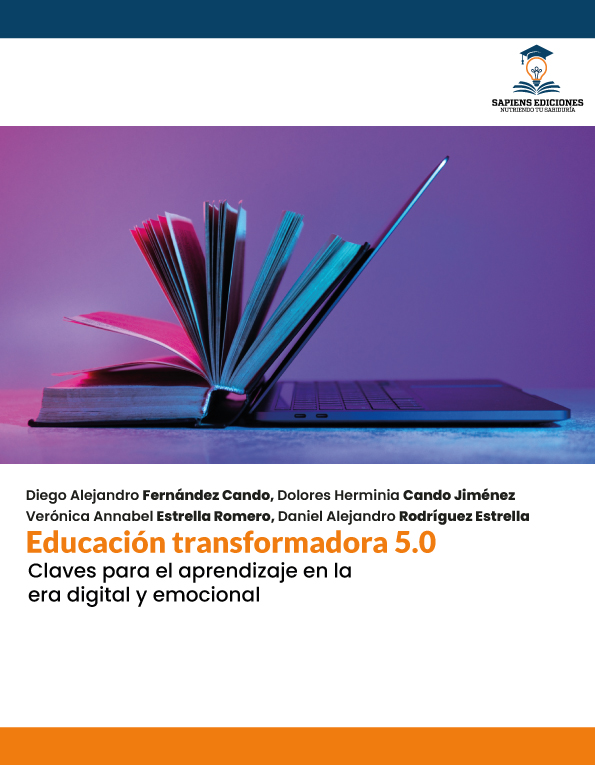
Educación transformadora 5.0: Claves para el aprendizaje en la era digital y emocional presenta una propuesta académica orientada a repensar los modelos educativos contemporáneos desde una perspectiva humanista, ética y tecnológica. La obra analiza la evolución hacia la Educación 5.0, integrando inteligencia artificial, educación emocional, metodologías activas, inclusión y sostenibilidad educativa, con énfasis en el aprendizaje centrado en la persona, el liderazgo pedagógico y la transformación institucional responsable.
Publicado: 30 enero de 2026
ISBN: 978-9942-7461-5-3
Derechos de autor: © 2026 Diego Alejandro Fernández Cando; Dolores Herminia Cando Jiménez; Verónica Annabel Estrella Romero; Daniel Alejandro Rodríguez Estrella

Licencia: Esta obra está bajo una
Creative Commons Atribución-NoComercial-CompartirIgual 4.0
Creative Commons Atribución-NoComercial-CompartirIgual 4.0
Autores
-

Instituto Tecnológico Internacional Los Andes, Loja - Ecuador
-

-

-


Sinopsis
Educación Transformadora 5.0: Claves para el Aprendizaje en la Era Digital y Emocional presenta una reflexión académica y crítica sobre los nuevos paradigmas educativos que emergen en un contexto marcado por la convergencia entre tecnología, emoción y humanismo. Desde el enfoque de la Educación 5.0, la obra analiza cómo la inteligencia artificial, las tecnologías emergentes, la educación emocional, la inclusión y la ética digital se integran para redefinir los procesos de enseñanza y aprendizaje en los distintos niveles educativos. Dirigido a docentes, investigadores, directivos y responsables de políticas educativas, el libro ofrece fundamentos teóricos, análisis contemporáneos y orientaciones estratégicas que permiten repensar la práctica pedagógica, fortalecer el desarrollo integral del estudiante y promover una educación innovadora, ética, sostenible y centrada en la persona.
Palabras clave: Educación 5.0; transformación educativa; inteligencia artificial en educación; educación emocional; innovación pedagógica; humanismo digital; aprendizaje integral.
Autores
-
-
-
-
Citas
Ainscow, M. (2020). Promoting inclusion and equity in education: Lessons from international experiences. Nordic Journal of Studies in Educational Policy, 6(1), 7–16. https://doi.org/10.1080/20020317.2020.1729587
Al-Azawei, A., Serenelli, F., & Lundqvist, K. (2016). Universal design for learning (UDL): A content analysis of peer-reviewed journal papers from 2012 to 2015. Journal of the Scholarship of Teaching and Learning, 16(3), 39–56. https://doi.org/10.14434/josotl.v16i3.19295
Al-Azawei, A., Parslow, P., & Lundqvist, K. (2017). Investigating the effect of learning styles in a blended e-learning system: An extension of the technology acceptance model (TAM). Australasian Journal of Educational Technology, 33(2), 1–23. https://doi.org/10.14742/ajet.2741
Argyris, C., & Schön, D. (1996). Organizational learning II: Theory, method, and practice. Addison-Wesley.
Armenakis, A. A., & Harris, S. G. (2009). Reflections: Our journey in organizational change research and practice. Journal of Change Management, 9(2), 127–142. https://doi.org/10.1080/14697010902879079
Austin, J. E., & Seitanidi, M. M. (2012). Collaborative value creation: A review of partnering between nonprofits and businesses. Nonprofit and Voluntary Sector Quarterly, 41(5), 726–758. https://doi.org/10.1177/0899764012450777
Banks, J. A. (2016). Cultural diversity and education: Foundations, curriculum, and teaching (6th ed.). Routledge.
Bellei, C., Valenzuela, J. P., Vanni, X., & Contreras, D. (2020). School leadership in Latin America: Educational reform and social inequality. Educational Management Administration & Leadership, 48(3), 487–506. https://doi.org/10.1177/1741143219879653
Biesta, G. (2015). Good education in an age of measurement: Ethics, politics, democracy. Routledge.
Bolívar, A. (2012). Políticas educativas y liderazgo pedagógico. Aljibe.
Bolívar, A. (2019). Liderazgo educativo para la justicia social. Revista de Educación, (385), 13–41. https://doi.org/10.4438/1988-592X-RE-2019-385-410
Booth, T., & Ainscow, M. (2016). Index for inclusion: A guide to school development (4th ed.). Centre for Studies on Inclusive Education.
Bryk, A. S., Gomez, L. M., Grunow, A., & LeMahieu, P. G. (2015). Learning to improve: How America’s schools can get better at getting better. Harvard Education Press.
Buckingham, D. (2015). The media education manifesto. Polity Press.
Buckingham, D. (2020). Epistemic crisis, education and fake news. Educational Philosophy and Theory, 52(12), 1–10. https://doi.org/10.1080/00131857.2020.1786388
Burgstahler, S. (2015). Universal design in higher education: From principles to practice. Harvard Education Press.
CAST. (2018). Universal Design for Learning guidelines version 2.2. http://udlguidelines.cast.org
CEPAL. (2020). La educación en tiempos de la pandemia de COVID-19. Naciones Unidas.
Cook, A. M., & Polgar, J. M. (2015). Assistive technologies: Principles and practice (4th ed.). Elsevier.
Darling-Hammond, L., Hyler, M. E., & Gardner, M. (2017). Effective teacher professional development. Learning Policy Institute.
Datnow, A., & Hubbard, L. (2016). Teacher capacity for and beliefs about data-driven decision making: A literature review. Journal of Educational Change, 17(1), 7–28. https://doi.org/10.1007/s10833-015-9264-2
Datnow, A., & Park, V. (2019). Professional collaboration with purpose. Routledge.
Deardorff, D. K. (2020). Manual for developing intercultural competencies. UNESCO.
Dexter, S. (2018). Leadership for IT in schools. Educational Administration Quarterly, 54(3), 1–33. https://doi.org/10.1177/0013161X18769066
Dede, C., Richards, J., & Saxberg, B. (2017). Learning engineering for the future of education. Educational Technology, 57(4), 33–38.
Dussel, I. (2020). La escuela en la pandemia. Revista Propuesta Educativa, 54, 4–16.
Edmondson, A. (2019). The fearless organization. Wiley.
Etzkowitz, H., & Zhou, C. (2017). The triple helix: University–industry–government innovation. Routledge.
Floridi, L., et al. (2018). AI4People—An ethical framework for a good AI society. Minds and Machines, 28, 689–707. https://doi.org/10.1007/s11023-018-9482-5
Fullan, M. (2016). The new meaning of educational change (5th ed.). Teachers College Press.
Fullan, M. (2020). Leading in a culture of change. Jossey-Bass.
Gardner, H. (2011). Frames of mind: The theory of multiple intelligences. Basic Books.
Hall, G. E., & Hord, S. M. (2015). Implementing change: Patterns, principles, and potholes (4th ed.). Pearson.
Hargreaves, A., & O’Connor, M. T. (2018). Collaborative professionalism. Corwin.
Hattie, J., & Timperley, H. (2007). The power of feedback. Review of Educational Research, 77(1), 81–112. https://doi.org/10.3102/003465430298487
Heifetz, R., Grashow, A., & Linsky, M. (2009). The practice of adaptive leadership. Harvard Business Press.
Hilton, J. (2016). Open educational resources and college textbook choices. Educational Technology Research and Development, 64, 573–590. https://doi.org/10.1007/s11423-016-9434-9
Holmes, W., Bialik, M., & Fadel, C. (2019). Artificial intelligence in education. Center for Curriculum Redesign.
Immordino-Yang, M. H., Darling-Hammond, L., & Krone, C. R. (2019). The brain basis for integrated social, emotional, and academic development. Aspen Institute.
Janssen, M., et al. (2017). Data governance: Organizing data for trustworthy smart societies. Government Information Quarterly, 34(1), 1–8. https://doi.org/10.1016/j.giq.2017.01.001
Jobin, A., Ienca, M., & Vayena, E. (2019). The global landscape of AI ethics guidelines. Nature Machine Intelligence, 1, 389–399. https://doi.org/10.1038/s42256-019-0088-2
Kimmons, R. (2020). Current trends in digital citizenship education. Education and Information Technologies, 25, 2895–2915. https://doi.org/10.1007/s10639-019-10008-9
Kools, M., & Stoll, L. (2016). What makes a school a learning organisation? OECD.
Kotter, J. P. (2012). Leading change. Harvard Business Review Press.
Kotter, J. P. (2014). Accelerate! Harvard Business Review, 92(11), 44–58.
Leithwood, K., Harris, A., & Hopkins, D. (2020). Seven strong claims about successful school leadership. School Leadership & Management, 40(1), 5–22. https://doi.org/10.1080/13632434.2019.1596077
Lozano, R., et al. (2015). A review of sustainability in higher education. Journal of Cleaner Production, 106, 1–18. https://doi.org/10.1016/j.jclepro.2014.09.090
Makransky, G., & Petersen, G. B. (2019). Immersive VR and learning. Educational Psychology Review, 31, 479–503. https://doi.org/10.1007/s10648-019-09480-9
Mandinach, E. B., & Gummer, E. S. (2016). What does it mean for teachers to be data literate? Teachers College Record, 118(3), 1–42.
Marsick, V. J., & Watkins, K. E. (2018). Informal and incidental learning. Routledge.
Meyer, A., Rose, D. H., & Gordon, D. (2014). Universal design for learning: Theory and practice. CAST.
Moore, J. (2016). Shared value ecosystems. Harvard Business School.
Murillo, F. J., & Román, M. (2011). School leadership in Latin America. Educational Management Administration & Leadership, 39(3), 339–361. https://doi.org/10.1177/1741143210390056
Mystakidis, S. (2022). Metaverse. Computers, 11(3), 31. https://doi.org/10.3390/computers11030031
Nussbaum, M. C. (2016). Not for profit: Why democracy needs the humanities. Princeton University Press.
OECD. (2019). Education 2030: The future of education and skills. OECD Publishing.
Opfer, V. D., & Pedder, D. (2011). Conceptualizing teacher professional learning. Review of Educational Research, 81(3), 376–407. https://doi.org/10.3102/0034654311413609
Parong, J., & Mayer, R. E. (2018). Learning science in immersive VR. Journal of Educational Psychology, 110(6), 785–797. https://doi.org/10.1037/edu0000241
Radianti, J., et al. (2020). A systematic review of immersive VR applications. Computers & Education, 147, 103778. https://doi.org/10.1016/j.compedu.2019.103778
Redecker, C. (2017). European framework for the digital competence of educators (DigCompEdu). European Commission.
Resnick, M. (2017). Lifelong kindergarten. MIT Press.
Rizvi, F., & Lingard, B. (2010). Globalizing education policy. Routledge.
Robinson, V. M. J., Lloyd, C. A., & Rowe, K. J. (2009). The impact of leadership on student outcomes. Educational Administration Quarterly, 44(5), 635–674. https://doi.org/10.1177/0013161X08321509
Schein, E. H. (2017). Organizational culture and leadership (5th ed.). Wiley.
Selwyn, N. (2016). Education and technology: Key issues and debates. Bloomsbury.
Selwyn, N. (2020). Should robots replace teachers? Polity Press.
Senge, P. M., et al. (2012). Schools that learn. Crown Business.
Sterling, S. (2010). Learning for resilience. Journal of Education for Sustainable Development, 4(1), 25–38. https://doi.org/10.1177/097340820900400106
Timperley, H., et al. (2007). Teacher professional learning and development. OECD.
Trucano, M. (2016). ICT in education. World Bank.
UNESCO. (2020). Education in a post-COVID world. UNESCO.
UNESCO. (2021). Reimagining our futures together. UNESCO.
Van Deursen, A., & van Dijk, J. (2019). The first-level digital divide. New Media & Society, 21(2), 354–375. https://doi.org/10.1177/1461444818797082
Vuorikari, R., et al. (2022). DigComp 2.2. European Commission.
Warschauer, M. (2011). Learning in the cloud. Teachers College Press.
Wenger-Trayner, E., & Wenger-Trayner, B. (2015). Learning in landscapes of practice. Routledge.
Williamson, B. (2017). Big data in education. Sage.
Zembylas, M. (2015). Emotion and traumatic conflict. Oxford Review of Education, 41(2), 253–267. https://doi.org/10.1080/03054985.2015.1021194
Autores
-
-
-
-
Como citar
APA:
Estrella Romero, V. A. (2026). Educación Transformadora 5.0: Claves para el Aprendizaje en la Era Digital y Emocional. Sapiens Ediciones.
https://sapiensediciones.com/product/educacion-transformadora-5-0/
Estrella Romero, V. A. (2026). Educación Transformadora 5.0: Claves para el Aprendizaje en la Era Digital y Emocional. Sapiens Ediciones.
https://sapiensediciones.com/product/educacion-transformadora-5-0/
Vancouver:
Estrella Romero VA. Educación Transformadora 5.0: Claves para el Aprendizaje en la Era Digital y Emocional. Sapiens Ediciones; 2026.
https://sapiensediciones.com/product/educacion-transformadora-5-0/
Estrella Romero VA. Educación Transformadora 5.0: Claves para el Aprendizaje en la Era Digital y Emocional. Sapiens Ediciones; 2026.
https://sapiensediciones.com/product/educacion-transformadora-5-0/
Autores
-
-
-
-
Indexaciones

Esta obra cuenta con registro ISBN.
Autores
-
-
-
-