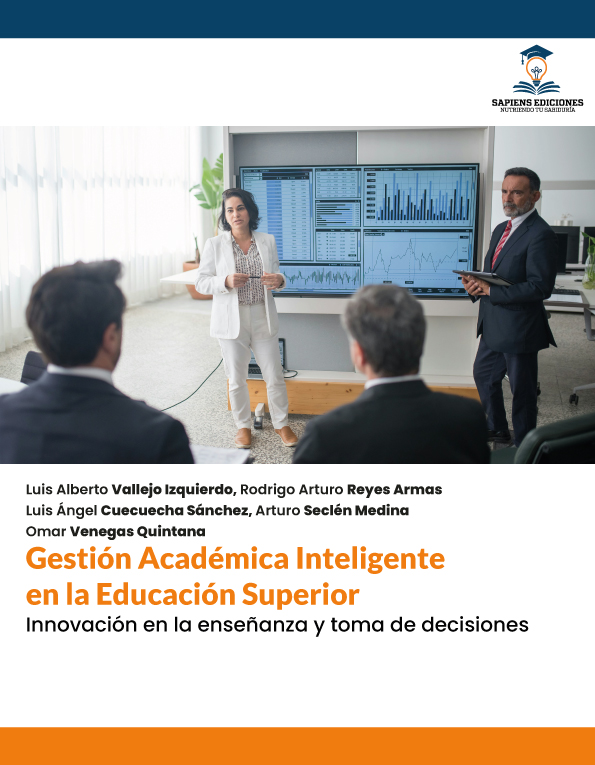
Gestión Académica Inteligente en la Educación Superior: Innovación en la enseñanza y toma de decisiones propone una visión estratégica sobre la transformación universitaria en la era de los datos y la inteligencia artificial. La obra desarrolla un modelo sistémico que integra liderazgo académico, gobernanza basada en evidencia y analítica del aprendizaje como pilares para fortalecer la calidad institucional y la toma de decisiones informadas. Desde una perspectiva estructurada y humanista, examina la transición desde modelos administrativos tradicionales hacia arquitecturas institucionales orientadas por datos con sentido pedagógico y ético, promoviendo mejora continua, sostenibilidad y responsabilidad académica.
Publicado: 28 de Febrero del 2026
ISBN: 978-9942-7461-7-7
Derechos de autor: © 2026 Luis Alberto Vallejo Izquierdo; Rodrigo Arturo Reyes Armas; Luis Ángel Cuecuecha Sánchez; Arturo Seclén Medina; Omar Venegas Quintana

Licencia: Esta obra está bajo una Creative Commons Atribución-NoComercial-CompartirIgual 4.0
Autores
-

Pontificia Universidad Católica del Ecuador, Quito - Ecuador
-

-

-

-


Sinopsis
Gestión Académica Inteligente en la Educación Superior: Innovación en la enseñanza y toma de decisiones propone una visión estratégica sobre la transformación universitaria en la era de los datos y la inteligencia artificial. La obra desarrolla un modelo sistémico que integra liderazgo académico, gobernanza basada en evidencia y analítica del aprendizaje para fortalecer la calidad institucional y la toma de decisiones informadas. A través de un enfoque estructurado y humanista, el libro examina la transición desde modelos administrativos tradicionales hacia arquitecturas institucionales orientadas por datos con sentido pedagógico y ético. Dirigido a directivos, docentes e investigadores, ofrece herramientas conceptuales y aplicadas para construir universidades adaptativas, responsables y comprometidas con la mejora continua y el desarrollo sostenible.
Palabras clave: gestión académica inteligente; educación superior; gobernanza universitaria; analítica del aprendizaje; transformación digital.
Autores
-
-
-
-
-
Citas
Argyris, C., & Schön, D. (1996). Organizational learning II: Theory, method, and practice. Addison-Wesley.
Bean, J. P. (1980). Dropouts and turnover: The synthesis and test of a causal model of student attrition. Research in Higher Education, 12(2), 155–187. https://doi.org/10.1007/BF00976194
Bender, E., Gebru, T., McMillan-Major, A., & Shmitchell, S. (2021). On the dangers of stochastic parrots. Proceedings of the ACM Conference on Fairness, Accountability, and Transparency, 610–623. https://doi.org/10.1145/3442188.3445922
Biesta, G. (2010). Good education in an age of measurement. Paradigm Publishers.
Birnbaum, R. (1988). How colleges work: The cybernetics of academic organization and leadership. Jossey-Bass.
Black, P., & Wiliam, D. (1998). Assessment and classroom learning. Assessment in Education, 5(1), 7–74. https://doi.org/10.1080/0969595980050102
Bleiklie, I., & Kogan, M. (2007). Organization and governance of universities. Higher Education Policy, 20(4), 477–493. https://doi.org/10.1057/palgrave.hep.8300167
Broadbent, J., & Poon, W. (2015). Self-regulated learning strategies and academic achievement in online higher education. Internet and Higher Education, 27, 1–13. https://doi.org/10.1016/j.iheduc.2015.04.007
Brown, M. E., & Treviño, L. K. (2006). Ethical leadership. The Leadership Quarterly, 17(6), 595–616. https://doi.org/10.1016/j.leaqua.2006.10.004
Bryson, J. M. (2018). Strategic planning for public and nonprofit organizations (5th ed.). Jossey-Bass.
Campbell, J. P., DeBlois, P., & Oblinger, D. G. (2007). Academic analytics. EDUCAUSE Review, 42(4), 40–57. https://er.educause.edu/articles/2007/7/academic-analytics
Chi, M. T. H., & Wylie, R. (2014). The ICAP framework. Educational Psychologist, 49(4), 219–243. https://doi.org/10.1080/00461520.2014.965823
Clow, D. (2012). The learning analytics cycle. Proceedings of the 2nd International Conference on Learning Analytics and Knowledge, 134–138. https://doi.org/10.1145/2330601.2330636
Colquitt, J. A. (2001). On the dimensionality of organizational justice. Journal of Applied Psychology, 86(3), 386–400. https://doi.org/10.1037/0021-9010.86.3.386
Creswell, J. W., & Plano Clark, V. (2018). Designing and conducting mixed methods research (3rd ed.). Sage.
Davenport, T., & Ronanki, R. (2018). Artificial intelligence for the real world. Harvard Business Review, 96(1), 108–116. https://hbr.org/2018/01/artificial-intelligence-for-the-real-world
Dawson, S. (2008). A study of social networks in online learning. British Journal of Educational Technology, 39(5), 919–932. https://doi.org/10.1111/j.1467-8535.2007.00792.x
Dekker, G., Pechenizkiy, M., & Vleeshouwers, J. (2009). Predicting students at risk. Proceedings of EDM 2009, 41–50. https://educationaldatamining.org/EDM2009
DiMaggio, P. J., & Powell, W. W. (1983). The iron cage revisited. American Sociological Review, 48(2), 147–160. https://doi.org/10.2307/2095101
Dill, D. D., & Beerkens, M. (2010). Public policy for academic quality. Springer. https://doi.org/10.1007/978-90-481-3754-1
Few, S. (2012). Show me the numbers. Analytics Press.
Floridi, L. (2013). The ethics of information. Oxford University Press. https://doi.org/10.1093/acprof:oso/9780199641321.001.0001
Foucault, M. (1977). Discipline and punish. Pantheon Books.
Fredricks, J., Blumenfeld, P., & Paris, A. (2004). School engagement. Review of Educational Research, 74(1), 59–109. https://doi.org/10.3102/00346543074001059
Fullan, M. (2007). The new meaning of educational change (4th ed.). Teachers College Press.
Godet, M. (2000). The art of scenarios and strategic planning. Technological Forecasting and Social Change, 65(1), 3–22. https://doi.org/10.1016/S0040-1625(99)00120-1
Hannan, M., & Freeman, J. (1984). Structural inertia and organizational change. American Sociological Review, 49(2), 149–164. https://doi.org/10.2307/2095567
Harvey, L. (2005). A history and critique of quality evaluation in the UK. Quality Assurance in Education, 13(4), 263–276. https://doi.org/10.1108/09684880510700608
Heifetz, R., Grashow, A., & Linsky, M. (2009). The practice of adaptive leadership. Harvard Business Press.
Holmes, W., Persson, J., Chounta, I., Wasson, B., & Dimitrova, V. (2022). Artificial intelligence and education. Computers and Education: Artificial Intelligence, 3, 100069. https://doi.org/10.1016/j.caeai.2022.100069
Janis, I. (1982). Groupthink. Houghton Mifflin.
Johnstone, D. B. (2004). Cost-sharing and tuition. Higher Education in Europe, 29(1), 31–44. https://doi.org/10.1080/0379772042000194183
Kahneman, D. (2011). Thinking, fast and slow. Farrar, Straus and Giroux.
Kaplan, R., & Norton, D. (2001). Strategy-focused organization. Harvard Business School Press.
Kirkpatrick, D., & Kirkpatrick, J. (2006). Evaluating training programs. Berrett-Koehler.
Kotter, J. (1996). Leading change. Harvard Business School Press.
Lewin, K. (1951). Field theory in social science. Harper & Row.
Luckin, R., Holmes, W., Griffiths, M., & Forcier, L. (2016). Intelligence unleashed. Pearson.
Mandinach, E., & Gummer, E. (2016). What does it mean for teachers to be data literate? Teachers College Record, 118(11). https://www.tcrecord.org
Marginson, S. (2016). The dream is over. University of California Press.
Mayer, R., Davis, J., & Schoorman, F. (1995). An integrative model of organizational trust. Academy of Management Review, 20(3), 709–734. https://doi.org/10.5465/amr.1995.9508080335
Mintzberg, H. (1994). The rise and fall of strategic planning. Free Press.
Mulder, M. (2014). Conceptions of professional competence. International Journal of Training and Development, 18(1), 1–15. https://doi.org/10.1111/ijtd.12029
O’Neil, C. (2016). Weapons of math destruction. Crown.
Pane, J., et al. (2015). Continued progress in personalized learning. RAND Corporation. https://www.rand.org
Pfeffer, J., & Sutton, R. (2006). Hard facts, dangerous half-truths. Harvard Business School Press.
Rogers, E. (2003). Diffusion of innovations (5th ed.). Free Press.
Saaty, T. (2008). Decision making with the analytic hierarchy process. International Journal of Services Sciences, 1(1), 83–98. https://doi.org/10.1504/IJSSCI.2008.017590
Schein, E. (2010). Organizational culture and leadership (4th ed.). Jossey-Bass.
Scott, P. (2014). The global transformation of higher education. Routledge.
Shattock, M. (2010). Managing good governance. Higher Education Quarterly, 64(1), 56–73. https://doi.org/10.1111/j.1468-2273.2009.00424.x
Shute, V. (2008). Focus on formative feedback. Review of Educational Research, 78(1), 153–189. https://doi.org/10.3102/0034654307313795
Simon, H. A. (1997). Administrative behavior (4th ed.). Free Press.
Spillane, J. (2006). Distributed leadership. Jossey-Bass.
Taleb, N. (2007). The black swan. Random House.
Tinto, V. (2017). Through the eyes of students. Journal of College Student Retention, 19(3), 254–269. https://doi.org/10.1177/1521025115621917
Westerman, G., Bonnet, D., & McAfee, A. (2014). Leading digital. Harvard Business Review Press.
Weick, K., & Quinn, R. (1999). Organizational change and development. Annual Review of Psychology, 50, 361–386. https://doi.org/10.1146/annurev.psych.50.1.361
Yorke, M. (2006). Employability in higher education. Higher Education Academy.
Zawacki-Richter, O., Marín, V., Bond, M., & Gouverneur, F. (2019). Systematic review of AI in higher education. International Journal of Educational Technology in Higher Education, 16(39). https://doi.org/10.1186/s41239-019-0171-0
Autores
-
-
-
-
-
Como citar
APA:
Vallejo Izquierdo, L. A., Reyes Armas, R. A., Cuecuecha Sánchez, L. Á., Seclén Medina, A., & Venegas Quintana, O. (2026). Gestión Académica Inteligente en la Educación Superior: Innovación en la enseñanza y toma de decisiones. Sapiens Ediciones.
https://sapiensediciones.com/product/gestion-academica-inteligente-en-la-educacion-superior/
Vallejo Izquierdo, L. A., Reyes Armas, R. A., Cuecuecha Sánchez, L. Á., Seclén Medina, A., & Venegas Quintana, O. (2026). Gestión Académica Inteligente en la Educación Superior: Innovación en la enseñanza y toma de decisiones. Sapiens Ediciones.
https://sapiensediciones.com/product/gestion-academica-inteligente-en-la-educacion-superior/
Vancouver:
Vallejo Izquierdo LA, Reyes Armas RA, Cuecuecha Sánchez LÁ, Seclén Medina A, Venegas Quintana O. Gestión Académica Inteligente en la Educación Superior: Innovación en la enseñanza y toma de decisiones. Sapiens Ediciones; 2026.
https://sapiensediciones.com/product/gestion-academica-inteligente-en-la-educacion-superior/
Vallejo Izquierdo LA, Reyes Armas RA, Cuecuecha Sánchez LÁ, Seclén Medina A, Venegas Quintana O. Gestión Académica Inteligente en la Educación Superior: Innovación en la enseñanza y toma de decisiones. Sapiens Ediciones; 2026.
https://sapiensediciones.com/product/gestion-academica-inteligente-en-la-educacion-superior/
Autores
-
-
-
-
-
Indexaciones

Esta obra cuenta con registro ISBN.
Autores
-
-
-
-
-