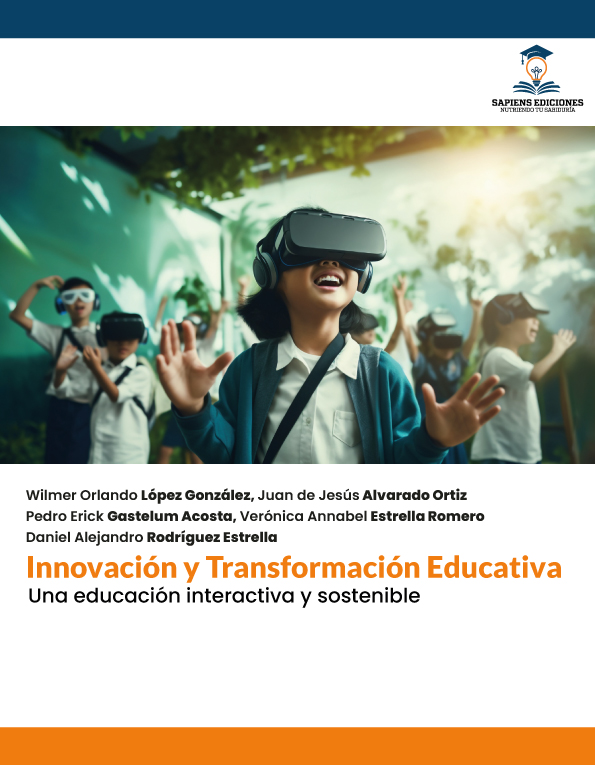
Innovación y Transformación Educativa: Una educación interactiva y sostenible analiza los desafíos de la educación en el siglo XXI desde los enfoques de Educación 4.0 y 5.0. La obra aborda la innovación pedagógica, el uso ético de la tecnología y la inteligencia artificial, los entornos virtuales de aprendizaje y el liderazgo educativo, proponiendo una visión humanista orientada al aprendizaje permanente, la inclusión y la sostenibilidad educativa.
Publicado: 15 de diciembre del 2025
ISBN: 978-9942-7461-2-2
Derechos de autor: © 2025 Wilmer Orlando López González; Juan de Jesús Alvarado Ortiz; Pedro Erick Gastelum Acosta; Verónica Annabel Estrella Romero; Daniel Alejandro Rodríguez Estrella

Licencia: Esta obra está bajo una
Creative Commons Atribución-NoComercial-CompartirIgual 4.0
Creative Commons Atribución-NoComercial-CompartirIgual 4.0
Autores
-

Universidad Nacional de Educación, Azogues - Ecuador
-

-

-

-


Sinopsis
Innovación y Transformación Educativa: Una educación interactiva y sostenible ofrece una mirada crítica y actual sobre los procesos de cambio que atraviesan los sistemas educativos en el siglo XXI. A través de los enfoques de Educación 4.0 y 5.0, la obra analiza la integración de la tecnología, la inteligencia artificial, la innovación pedagógica y la evaluación educativa desde una perspectiva ética, humanista e inclusiva. Dirigido a docentes, investigadores y directivos, el libro propone reflexiones y orientaciones que contribuyen a repensar la práctica educativa y a construir modelos formativos más pertinentes, equitativos y sostenibles.
Palabras clave: innovación educativa; transformación educativa; educación 4.0 y 5.0; inteligencia artificial en educación; innovación pedagógica; evaluación educativa; educación sostenible.
Autores
-
-
-
-
-
Citas
Abrams, Z. I. (2019). Technology-mediated L2 interaction. Routledge. https://doi.org/10.4324/9781315166846
Ainsworth, S. (2014). Multiple representations. Learning and Instruction, 30, 1–5. https://doi.org/10.1016/j.learninstruc.2013.12.001
Alammary, A. (2019). Blended learning models. Education and Information Technologies, 24(2), 1081–1102. https://doi.org/10.1007/s10639-018-9789-7
Anderson, T. (2011). The theory and practice of online learning. AU Press. https://www.aupress.ca
Area, M. (2018). Educación digital y competencia mediática. Octaedro. https://octaedro.com
Barnett, R. (2018). The ecological university: A feasible utopia. Routledge. https://doi.org/10.4324/9781315199158
Bates, A. W. (2019). Teaching in a digital age. https://opentextbc.ca/teachinginadigitalage
Beetham, H. (2020). Rethinking pedagogy for a digital age. Routledge. https://doi.org/10.4324/9780429475400
Biesta, G. (2015). Good education in an age of measurement. Routledge. https://doi.org/10.4324/9781315638244
Biggs, J., & Tang, C. (2011). Teaching for quality learning at university (4th ed.). Open University Press. https://www.mheducation.co.uk/9780335242757
Bond, M., et al. (2020). Mapping research in student engagement and educational technology. International Journal of Educational Technology in Higher Education, 17(1), 1–30. https://doi.org/10.1186/s41239-019-0176-8
Boud, D., & Falchikov, N. (2006). Aligning assessment with long-term learning. Assessment & Evaluation in Higher Education, 31(4), 399–413. https://doi.org/10.1080/02602930600679050
Brookhart, S. (2017). How to give effective feedback. ASCD. https://www.ascd.org
CEPAL. (2022). Educación y transformación digital en América Latina. Naciones Unidas. https://www.cepal.org/es/publicaciones
Cabero-Almenara, J. (2015). Formación del profesorado universitario en TIC. Pixel-Bit, 46, 7–18. https://doi.org/10.12795/pixelbit.2015.i46.01
Christensen, C. (2011). Disrupting class. McGraw-Hill. https://www.mheducation.com
Creswell, J. W. (2018). Research design. SAGE. https://us.sagepub.com
Darling-Hammond, L. (2017). Teaching for deeper learning. Jossey-Bass. https://www.wiley.com
DeLuca, C. (2016). Assessment literacy. Teaching and Teacher Education, 57, 1–12. https://doi.org/10.1016/j.tate.2016.03.003
Dede, C. (2014). The role of digital technologies in deeper learning. Harvard Graduate School of Education. https://eric.ed.gov/?id=ED561110
Dillenbourg, P. (2013). Classroom orchestration. Computers & Education, 69, 485–492. https://doi.org/10.1016/j.compedu.2013.04.013
Domínguez, A. (2013). Gamification in e-learning. Computers in Human Behavior, 29(5), 189–197. https://doi.org/10.1016/j.chb.2012.12.020
Downes, S. (2012). Connectivism. IRRODL, 13(1). https://doi.org/10.19173/irrodl.v13i1.1186
Engeström, Y. (2001). Expansive learning. Journal of Education and Work, 14(1), 133–156. https://doi.org/10.1080/13639080020028747
European Commission. (2020). A European approach to micro-credentials. https://education.ec.europa.eu
Fidalgo-Blanco, Á. (2017). Methodological innovation. Education in the Knowledge Society, 18(4), 55–68. https://doi.org/10.14201/eks20171845568
Floridi, L. (2013). The ethics of information. Oxford University Press. https://doi.org/10.1093/acprof:oso/9780199641321.001.0001
Freeman, S., et al. (2014). Active learning increases student performance. PNAS, 111(23), 8410–8415. https://doi.org/10.1073/pnas.1319030111
Fullan, M. (2020). Leading in a culture of change. Jossey-Bass. https://www.wiley.com
García-Peñalvo, F. J. (2021). Transformación digital en educación superior. Education in the Knowledge Society, 22, e2364. https://doi.org/10.14201/eks.2364
Garrison, D. R. (2017). E-learning in the 21st century. Routledge. https://doi.org/10.4324/9781315667268
Gibson, D. (2016). Digital badges. Springer. https://doi.org/10.1007/978-3-319-15425-1
Goleman, D. (2017). Emotional intelligence. Bantam Books. https://www.penguinrandomhouse.com
Haenlein, M., & Kaplan, A. (2019). A brief history of artificial intelligence. California Management Review, 61(4), 5–14. https://doi.org/10.1177/0008125619864925
Hattie, J. (2012). Visible learning for teachers. Routledge. https://doi.org/10.4324/9780203181522
Holmes, W., Bialik, M., & Fadel, C. (2019). Artificial intelligence in education. Center for Curriculum Redesign. https://curriculumredesign.org
Hussin, A. A. (2018). Education 4.0 made simple. IJELS, 6(3), 92–97. https://doi.org/10.7575/aiac.ijels.v.6n.3p.92
Immordino-Yang, M. H. (2016). Emotions, learning, and the brain. Norton. https://wwnorton.com
Jonassen, D. (2012). Learning to solve problems. Routledge. https://doi.org/10.4324/9780203810057
Kolb, D. (2015). Experiential learning. Pearson. https://www.pearson.com
Merrill, M. D. (2002). First principles of instruction. ETR&D, 50(3), 43–59. https://doi.org/10.1007/BF02505024
Mishra, P. (2019). Context in teacher education. Journal of Teacher Education, 70(1), 1–6. https://doi.org/10.1177/0022487118808101
Morin, E. (2008). On complexity. Hampton Press. https://www.hamptonpress.com
OECD. (2019). OECD Learning Compass 2030. OECD Publishing. https://www.oecd.org/education/2030-project/
OECD. (2021). Education at a glance. OECD Publishing. https://doi.org/10.1787/b35a14e5-en
Prince, M. (2004). Does active learning work? Journal of Engineering Education, 93(3), 223–231. https://doi.org/10.1002/j.2168-9830.2004.tb00809.x
Redecker, C. (2017). Digital competence framework. EU Publications. https://doi.org/10.2760/38842
Salinas, J. (2012). Innovación docente y uso de las TIC. RUSC, 9(1), 22–33. https://doi.org/10.7238/rusc.v9i1.1196
Salmon, G. (2013). E-tivities. Routledge. https://doi.org/10.4324/9780203074640
Selwyn, N. (2019). Should robots replace teachers? Polity Press. https://politybooks.com
Siemens, G. (2014). Learning analytics. American Behavioral Scientist, 57(10), 1380–1400. https://doi.org/10.1177/0002764213498851
Stake, R. (2010). Qualitative research. Guilford Press. https://www.guilford.com
Sterling, S. (2010). Transformative learning and sustainability. JESD, 4(1), 17–33. https://doi.org/10.1177/097340820900400118
Tilbury, D. (2011). Education for sustainable development. EER, 17(2), 121–138. https://doi.org/10.1080/13504622.2010.533157
UNESCO. (2021). Reimagining our futures together. UNESCO. https://unesdoc.unesco.org/ark:/48223/pf0000379707
Vygotsky, L. S. (1978). Mind in society. Harvard University Press. https://www.hup.harvard.edu
Warschauer, M. (2003). Technology and social inclusion. MIT Press. https://mitpress.mit.edu
Weller, M. (2020). 25 years of ed tech. AU Press. https://www.aupress.ca
Williamson, B., & Eynon, R. (2020). Historical threads of AI in education. Learning, Media and Technology, 45(3), 223–235. https://doi.org/10.1080/17439884.2020.1798995
World Economic Forum. (2023). The future of jobs report. https://www.weforum.org/reports/the-future-of-jobs-report-2023
Zimmerman, B. J. (2002). Self-regulated learner. Theory Into Practice, 41(2), 64–70. https://doi.org/10.1207/s15430421tip4102_2
Autores
-
-
-
-
-
Como citar
APA:
López González, W. O., Alvarado Ortiz, J. J., Gastelum Acosta, P. E., Estrella Romero, V. A., & Rodríguez Estrella, D. A. (2025). Innovación y Transformación Educativa: Una educación interactiva y sostenible. Sapiens Ediciones.
https://sapiensediciones.com/product/innovacion-y-tranformacion-educativa/
López González, W. O., Alvarado Ortiz, J. J., Gastelum Acosta, P. E., Estrella Romero, V. A., & Rodríguez Estrella, D. A. (2025). Innovación y Transformación Educativa: Una educación interactiva y sostenible. Sapiens Ediciones.
https://sapiensediciones.com/product/innovacion-y-tranformacion-educativa/
Vancouver:
López González WO, Alvarado Ortiz JJ, Gastelum Acosta PE, Estrella Romero VA, Rodríguez Estrella DA. Innovación y Transformación Educativa: Una educación interactiva y sostenible.
Sapiens Ediciones; 2025.
https://sapiensediciones.com/product/innovacion-y-tranformacion-educativa/
López González WO, Alvarado Ortiz JJ, Gastelum Acosta PE, Estrella Romero VA, Rodríguez Estrella DA. Innovación y Transformación Educativa: Una educación interactiva y sostenible.
Sapiens Ediciones; 2025.
https://sapiensediciones.com/product/innovacion-y-tranformacion-educativa/
Autores
-
-
-
-
-
Indexaciones

Esta obra cuenta con registro ISBN.
Autores
-
-
-
-
-